By Cathy DeLozier
Photos by Jordan Wald
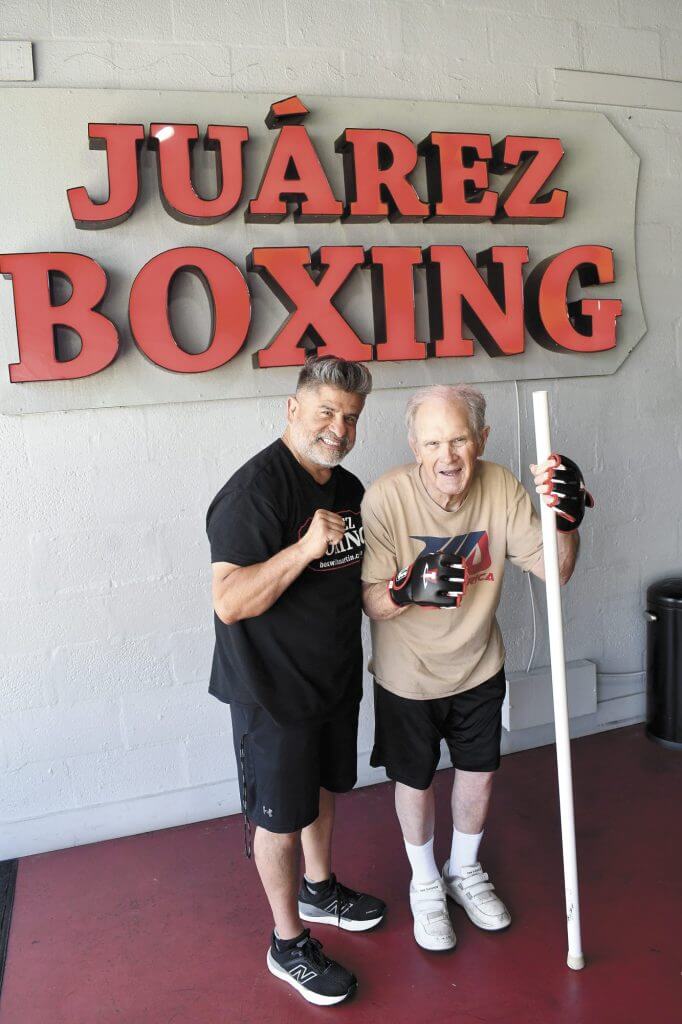
Unlike the famous quote from the 1999 movie Fight Club, “The first rule of fight club is: you don’t talk about fight club,” the PD Fight Club’s rule is: “HAVE FUN!” says Martin Juarez, owner and coach at Juarez Boxing in Irondale. During six weekly classes, more than 100 Parkinson’s boxers—deliberately not called patients—work out strenuously for an hour and 15 minutes supervised by the always smiling, encouraging and exuberant Juarez.
A retired, second-generation professional boxer, Juarez has been instructing boxers of all fitness levels for more than 20 years and added the PD Fight Club in 2018 after learning from a friend that recent studies had shown that non-contact boxing workouts could slow the progression of Parkinson’s disease and reduce symptoms such as tremors, stiffness and rigidity. “I love all my boxers and all my classes, but the PD Fight Club is my baby,” he says, nodding enthusiastically.
That baby has grown so much—along with his other classes—that he moved into his current 6,000-square-foot location on Crestwood Boulevard seven years ago to accommodate the ever-growing groups. PD Fight Club boxers attend one to three classes each week with sizes averaging 18 to 25 boxers, sometimes as many as 32. New members attend an orientation and assessment before they begin and are given a cinch bag, boxing gloves and wraps. Many opt to buy a black PD Fight Club tee shirt that has a graphic design of two fists with PD Fight Club written below and Determination is One Punch Away DOPA—a reference to dopamine, whose deficiency is responsible for most Parkinson’s symptoms.
On the back of the shirt is a quote from Muhammed Ali: “He who is not courageous enough to take risks will accomplish nothing in life.” The risk-takers, some using walkers, canes, wheelchairs and even motorized wheelchairs, start arriving about 15 minutes before class starts to put their equipment away, wrap their hands and put on their gloves. Jaurez says he had to implement a policy of opening the doors only 15 minutes before class because some were so eager to get out of the house and work out, they were showing up 45 minutes early.
“I’m called, ‘The Wrecker,’” says Dave McElroy, “because I wreck the schedule!” He explains that he was one of the ones who used to show up too early and attended four times each week. “But I’m down to three times, now. I think this is the best thing in the world,” he says. “It may be just an endorphin high, but afterwards, my hands don’t shake as bad, and my feet start to cooperate. I will not let this disease own me. Life is meant to be enjoyed, not endured. I have Parkinson’s, but I’m not dead!”
Nicknames are rich in boxing culture, usually reflecting a boxer’s style or personality. Juarez assigns the nicknames to everyone in the club and uses them throughout the sessions, calling across the room to Hank the Tank, the Silver Assassin, Rob the Rock, Bombs Away Beth, and Ruthless Ruth to keep up the good work. There is even a Second to Nun Sister Mary who works out in her habit.
Parkinson’s patients can feel isolated and depressed, and these workouts not only give them a chance to physically feel better, but emotionally and psychologically as well. While the classes can be a type of de facto support group and encouraging community, there is no chit chat or socializing during class; there’s no time.
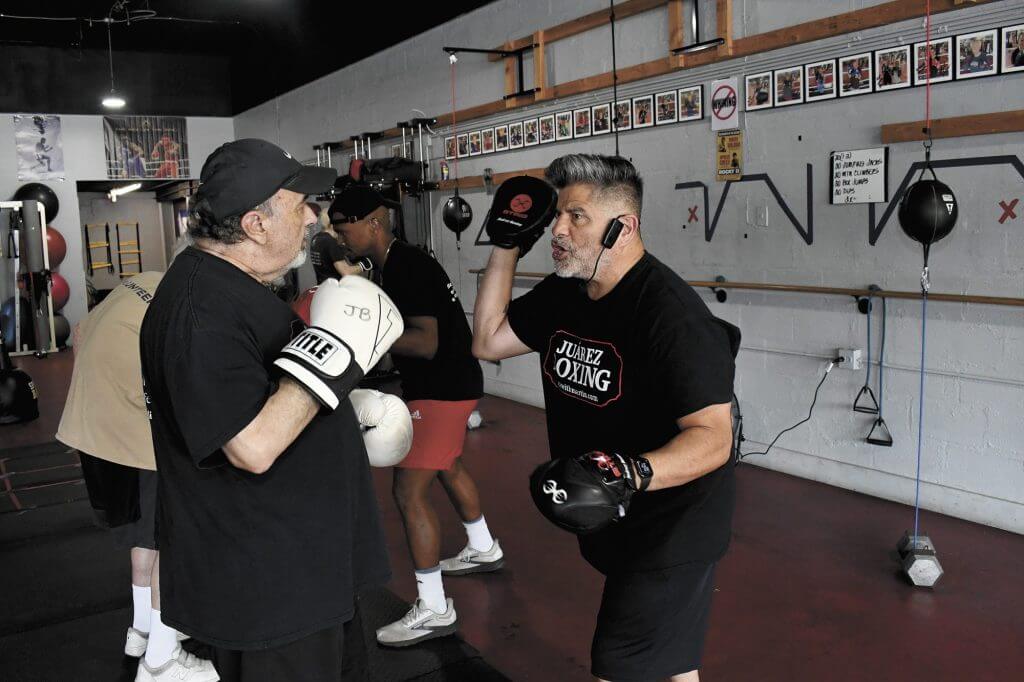
Classes start with a group warm-up, including memory exercises in which Jaurez, wearing his ever-present smile and wireless headset, asks the boxers what the five memory words were from the previous day’s session. Shouting and talking loudly rule the entire work out, as participants are encouraged to shout answers, count down from 10 at the beginning and end of each 45-second station, as well as the beginning and ending of each class. This exercise is to combat hypophonia, a symptom in which the muscles used in voice production are weakened by the disease.
After stretching with five-foot-long, light-weight PVC poles with rubber stoppers on the ends, the boxers take off in groups of two or three at each of nine stations around the room. Participants bob and weave their heads, punch speed bags, heel-toe walk a straight seam in the concrete floor and do drills and foot work for as many sets as they can, as fast as they can, for 45 seconds, before taking 15 seconds to run to the next station and start. Shouts of, “Ten, nine, eight, seven…” continually ring out throughout, along with the occasional, “War Eagle!” or “Roll Tide!”
Motivational music from the 50s, 60s and 70s is piped through the speakers to help keep everyone’s energy up and on track. All the while, Jaurez and his four coaches and volunteers—ushers with a smile, he calls them—are shouting encouragement, fist pumping and calling everyone by their boxer names throughout the gym.
To end class, Juarez leads the group in a cheer in which he shouts the words and the group shouts back:
“George Forman was a champ
And so was Ali!
But in this fight against Parkinson’s
That title goes to me!
Like Rumble in the Jungle
Great fights make headline news
And every day I fight my fight
And Parkinson’s will lose!
Fight! Fight! Fight!
PD Fight Club!”